
You're qualified
for the new post work force

This essay happened when I was driving. I spoke it into my phone, transcribed it, and put in images. I feel like I owe you a summary because it is a bit of a splatter of ideas, so here you go. I think this text traces a movement from private fear and fragmentation toward collective memory, shared labor, and synchronized time, asking what our work is when systems collapse and danger accelerates change. Transformation doesn’t happen alone but through practices that let people carry weight together. I'm trying to scratch an itch for a different way of being together, a different way through all the layers of emergency lasagna we are in. For me, because I've got this weird brain, the waiting room becomes my metaphor, my hope and experiment: a space where danger, grief, and hope are held long enough to become something else.
I don’t know how this is going to come together. By this, I mean this essay. I also mean history. I don’t know how we’re going to make it. But I also don’t know how I’m going to make it. It’s kind of meta right now. When are we going to run out of everything?
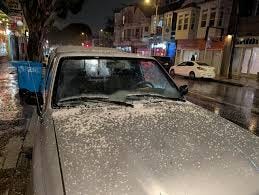
Last night there was hail the size of apple earbuds coming down in San Francisco. I saw ice covering the street for the first time there. I know it’s true because I saw a dog and their person trying to cross the street, and they couldn’t. It lasted just a few minutes.
I picked up my friend, who is the first person who had the patience to listen to me describe what I believe to be true: that the DHS will use the power of a supercomputer organized by Palantir to find and file documents on all of us who have ever had politically radical (or even moderately caring) ideas. That there will be a knock on our doors at some point in the near future, and we will be taken away. That we will be put into one of the fifteen new prisons being retrofitted out of warehouses across the U.S. First they come for the migrants and the people of color, and then everyone who protects them.
I wake up in the middle of the night knowing that this is true, regularly. My friend disagrees, thankfully. It’s so nice to be disagreed with.
It’s so hard to find a place to talk about what’s happening when there’s so much happening. There’s a level of avoidance here in the US that feels really important right now because people need to continue to survive in the current reality while we produce resistance to a future reality. We need to maintain a level of energy and optimism, which means we can’t always talk about everything that’s happening, and I’m learning to be okay with that. Someone told me the grapes are still being harvested because the workers are not going to leave until they absolutely have to. They need to pay rent.
I’m even learning not to judge the production of artwork that contains slightly more clearly communicated love than antagonism. Because my old job—raising the dead, showing how much worse things are than comfortable people know—is not really my job anymore. I need a different job. We all need different jobs.
What is our work in the apocalypse?
I think some of us are finding out. More and more of us will be finding out very soon. One of my jobs in the apocalypse is driving and crying. I think I look more and more like a middle-aged liberal white woman than I could ever have imagined. But looks can be deceiving due to the huge number of coyotes that are living inside of me, and the thin layer of a peri-professional class white lady allows me to steal massive amounts of soil from Walmart. So it has its upsides.
Today I was crying about something that struck me as strange. There are so many things to cry about right now, I expected to be more selective with my waterfalls. But today I was crying about one of Trump’s bad art projects called “Restoring Truth and Sanity to American History” where he has taken down all of the signage in public parks that describes the history of slavery, civil rights, and Indigenous history because the administration views these works as reflecting “improper partisan ideology”.
I know this work of taking down historical markers is symbolic. And I know we are no longer in a time of symbolic acts. On some level, what matters more than the symbol of history is that we have really learned history and that we carry it with us.
But there’s something about the erasure of people’s work that made me so sad. In a world where so much work is bullshit and so much is based on money, there are these rare moments when people have worked together to really do something and it has been acknowledged and marked somewhere that feels important, permanent, and “real”. Even carving out the space to do that is sacred. And for that work to be erased is hard.
Maybe, as I’ve written about before, there’s something about memory work that feels nearly impossible in such a forward-facing, accelerated reality. The work of archiving and remembering is a practice. And then there’s the further practice of making it pedagogical, accessible, and shareable.
Like I learned from reading The Deep by Rivers Solomon, it’s so important that people who hold the most difficult memories of our societies don’t have to do it alone. We really need to carry the weight of history together. So there’s something about taking away all of this memory practice—even though I know it’s not truly gone. Erasing it from public parks really hurts. But why would this hit me so hard?
I remembered something.
In 2012, I worked for a small nonprofit arts organization that provided art classes to people who might not otherwise get them. Some of that work was for children inside a public school system that was stripped of funds for creative programs. But a lot of our work was with incarcerated youth.
One of the most difficult days for me was when we went to a "nicer" place that held youth prisoners. It was supposed to be nice—a camp in Marin, and it was prettyi-ish. But it was still going to see kids in prison.

When we visited the different buildings to see what the young people living there were doing, I realized the kids were spending their days making infrastructure for California state parks. Incarcerated children were producing the famous green benches and welding parts of grills that would allow people to sit and eat a piece of hot meat while enjoying state parks that these kids had probably never gone to and probably never would. No one has time to wonder about where the bench came from when they carve out 2 hours to stop working and be in a park. The irony of this iron work is thick. To counterbalance it with educational signage about the history of slavery seems absurd and not enough. And yet whatever absurd amount of work, including the entire work of the civil rights movement, that led to some not-enough signifiers in parks about the history of slavery, is still a part of a long and incomplete process that should not be undone.
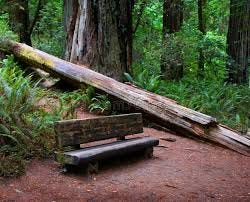
When I was getting my oil changed the other day, the man who changed it told me a small white lie—that there was something wrong with my car and I needed to see a mechanic right away. I asked if he knew one, and he asked for my phone number so he could call me back about it. When he called, he just asked me on a date. He didn’t have anything to say about my car.
When we went on a walk along my favorite little hike in Vallejo, he admitted he’d never been on a hike before. This person who grew up in the Bay Area, who has a pretty incredible record of undermining and pissing off the police in creative and beneficial ways, with a big life, with children and a family —he’s been to many prisons but he’s never been to a park.
For so many years, I’ve been wondering: what is our work in the apocalypse?
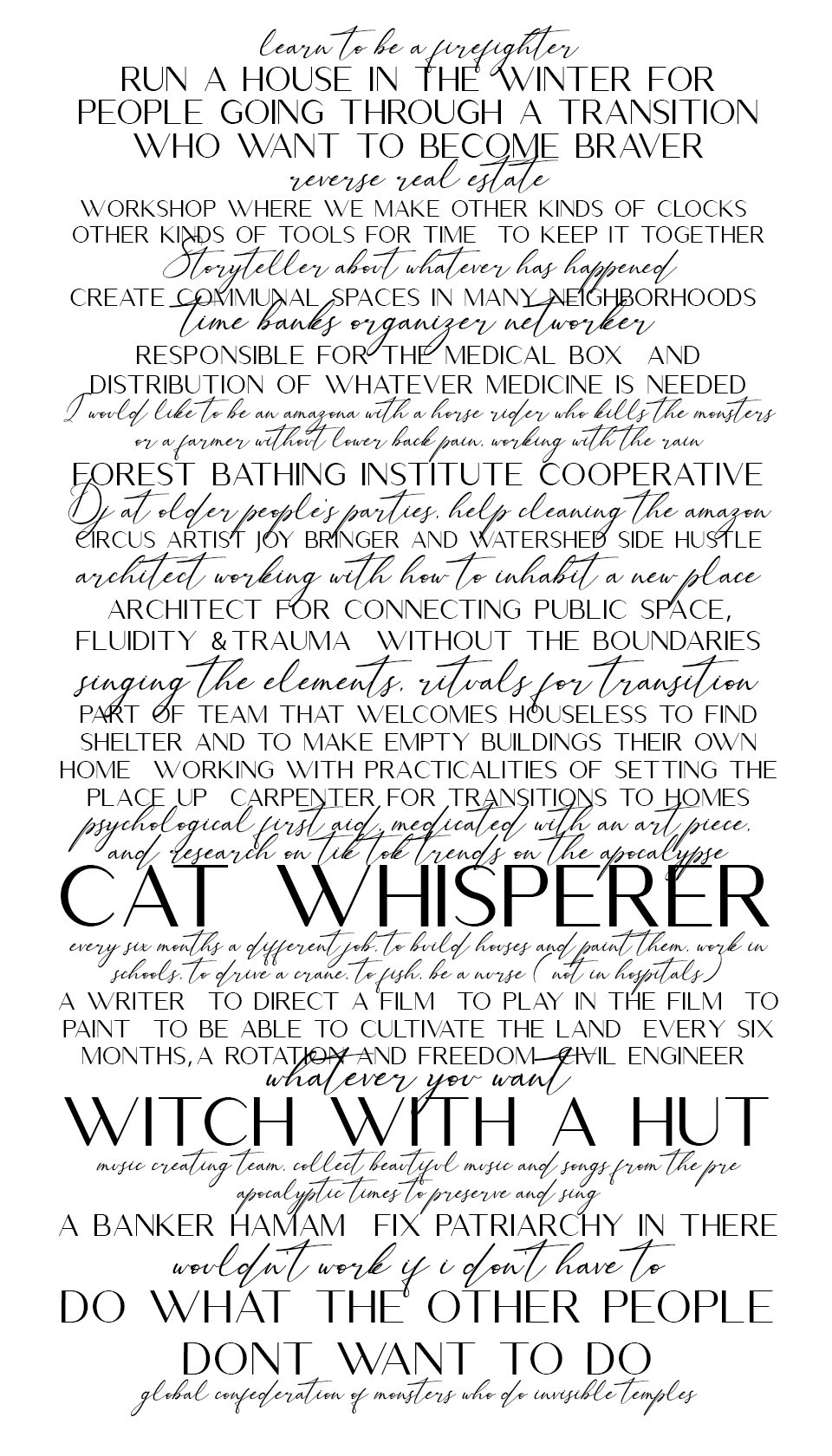
I’ve asked it at every Hologram workshop I’ve taught since 2020. What is your work in the apocalypse? What would you do if you weren’t worrying about money? What would you do if the systems we rely on—but that also rely on us to reproduce a reality that’s unfair to most people, especially prisoners—fell apart? What would we do? And what will we do when the scale of incarceration grows to include more and more of us?
What is our work in the apocalypse?
The other day, I was going to go on a date with someone I met online. We had been planning to meet for about six months. The day finally came, and I was actually excited. A phone call came. He said he would have to miss our date. He was going to Minneapolis.
I almost cried with joy. I was so excited to know someone who would cancel a date to go to Minneapolis. I had just read an article in N+1 called ICE vs. Everyone by Erin West, an activist writing about her experience in Minneapolis resisting mass deportations and abductions by ICE. She mentioned the crushes she had on the people she drove with as she went on patrol.
As I’m writing this, I’m smiling. I’ve had crushes on people I’ve been on patrol with. It’s real. It’s amazing how much doing something difficult and brave together brings us together and makes us see each other in different ways. Post-capitalist work is the most fun work. I can’t wait for everybody to find out. But she said something really important and unforgettable. She said there was a point when she could no longer go to work. Not in the first person:
After Good’s murder and Noem’s announcement that the number of ICE agents in Minnesota would triple, everyone I know cancelled their social plans. Lots of people called off work.
And then they did different work. They did what needed to be done. There was so much less fidgeting or wondering about what one should do. There was a gaping hole of energy that needed to be filled by everybody.
Over 30,000: Number of volunteers trained as constitutional observers who follow and document federal law enforcement activity across 77 of Minnesota’s 87 counties. The Immigrant Defense Network has registered around 2,000 volunteers for constitutional observer training weekly since the beginning of January.
$10–$20 million: Estimated revenue lost by Twin Cities businesses weekly, according to the Minneapolis Community Planning and Economic Development. Some businesses report a nearly 80 percent revenue decline year-over-year in the past two months.
From https://mspmag.com/arts-and-culture/by-the-numbers-ice-in-minnesota/#:~:text=25.8%25:%20Percentage%20of%20current,since%20the%20beginning%20of%20January.
So maybe seven percent of Minneapolis has figured out what their work is in the apocalypse. They’ve been studying it since George Floyd, and before.
Fugitive Planning
When I planned a LARP in 2020 with many friends about what would happen if we practiced the Hologram with consistent peer support all the way to 2050, we asked: what would we and our communities become? It was called Fugitive Planning. It was a real adventure.
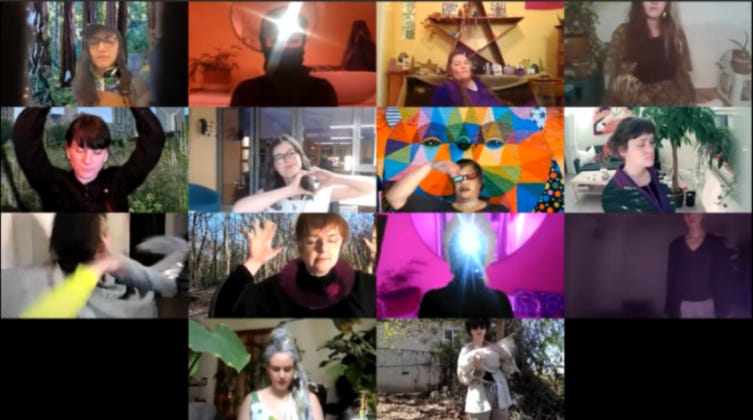
Many of my closest friends were involved. We imagined what our best selves would be in 2050. There was a difficult moment at the beginning of the project when I brought in a quote from Johanna Hedva about the idea that in order to change, we would have to do so under pressure—that we would have no choice, that change would be a response to the requirements of crisis.
“Crisis is perhaps the most generative thing of all—the forest fire necessary for new growth—for how many of us change unless we are forced to?”
-Johanna Hedva
Some people really struggled with me about this quote. They wanted to believe that we can change on our own. I don’t know the answer anymore, and it doesn't matter because crisis is here and it is an invitation. As the pressure rises, as things get scarier and more desperate, as people can’t afford groceries or gas, as we are abducted, as many of our family members in Venezuela, Cuba, Palestine and Iran lose life and major parts of their societies to empire, as we are disallowed from resisting, from being honest, from stopping violence, as it hails and breaks the windshield protecting us from reality— We are definitely forced to change.
In many projects, I’ve worked with the idea that you need a place you can go when you know you need to change but you don’t know how (The Social Spa for Collective Mutation is the most recent). What I didn’t know how to include in that phrase is that we don’t change individually. We change with the people around us.
Our habits don’t change in isolation. If we change but the people around us don’t, we often revert. That’s why, when trying to end an addiction, people sometimes have to separate themselves from those who enable or repeat it. Some people have to move away. That’s why it’s so interesting to see what’s happening in Minneapolis. The conditions changed for many people, and they had to change their habits collectively in order to respond. And that is what is going to happen to all of us.
I don’t know if we’re going to change fast enough.
If you’ve read my prior posts, you know I’m working on an art project in the middle of all this. I’m making a waiting room. I don’t know what we’re waiting for.
“we need people who can walk back and forth between the prophetic and the everyday,”
-Arnold Mindell
Miranda Mellis sent this amazing quote the other day. We do indeed need prophets who can also deal with material reality. There is no prophecy that can tell us what is going to happen that will outweigh what we are going to do. And what we are going to do will have to happen collectively.
For the waiting room, what I want is empty time. I’m asking for a dangerous amount of people’s time—two hours to visit an exhibition that’s in one room. Because I want people to sit for an entire hour, quietly, with others, and wait.
It’s not meditation. But it’s not unstructured either. I want us to sync our timelines together. I want it to be a place you can go when you know you need to change but you don’t know how—when you know you have to do it collectively. It’s a metaphysical experiment. And I know it’s going to work on some level that the art world will never be able to see, if it even exists anymore. It will be completely encrypted in the people who are around the project. As we do.
This project feels like it’s been coming for a long time—maybe 250 years. It carries so much information for me. So I needed to talk about it with someone who could handle a lot of information without being overwhelmed. I don’t know many people who can do that right now. Some people will want to stab my eyes out, but I described the project to ChatGPT and asked it to do what it does best: without being overwhelmed, tell me the patterns it sees. It told me the project is about the relationship between danger and transformation. I think that describes the moment we’re in. There is a high level of danger all around us in so many ways. And that heat has the potential to cause the kind of transformation we actually need.
I feel high saying that. And only by saying it out loud, over and over to myself—which I am literally doing right now—can I get high. No other drugs will work.
Understanding is never in isolation
I’ve never listened to a speech as much as I have listened to this one by Jesse Jackson, who just went upstairs yesterday. I listened to it on Democracy Now and then I listened to it in bed and then I played it with the dental hygienist at the dental school I went to today to get my teeth cleaned. I listened to it over lunch and I listened to it with a friend over the phone. Every time he says that he understands, I feel something in some part of my body that has no name. It feels like an alien wants to jump out of my body. Something that has been imprisoned in here wants to get out.
This is the speech by Jesse Jackson in 1988 when he was running for president. This was at the Democratic National Convention. Can you imagine having someone tell you that they understand? That they see you? And that they have some of what you have in you, inside of them? This is just the last 5 minutes of a 55 minute speech above, which starts at the 24 minute mark of that video. Watch it.
Why I cannot challenge you this way? “Jesse Jackson, you don’t understand my situation. You be on television. You don’t understand. I see you with the big people. You don’t understand my situation.”
I understand. You see me on TV, but you don’t know the me that makes me, me. They wonder, “Why does Jesse run?” because they see me running for the White House. They don’t see the house I’m running from. (Applause)
I have a story. I wasn’t always on television. Writers were not always outside my door. When I was born late one afternoon, October 8th, in Greenville, South Carolina, no writers asked my mother her name. Nobody chose to write down our address. My mama was not supposed to make it, and I was not supposed to make it. You see, I was born of a teen-age mother, who was born of a teen-age mother.
I understand. I know abandonment, and people being mean to you, and saying you’re nothing and nobody and can never be anything.
I understand. Jesse Jackson is my third name. I’m adopted. When I had no name, my grandmother gave me her name. My name was Jesse Burns until I was 12. So I wouldn’t have a blank space, she gave me a name to hold me over. I understand when nobody knows your name. I understand when you have no name.
I understand. I wasn’t born in the hospital. Mama didn’t have insurance. I was born in the bed at [the] house. I really do understand. Born in a three-room house, bathroom in the backyard, slop jar by the bed, no hot and cold running water.
I understand. Wallpaper used for decoration? No. For a windbreaker. I understand. I’m a working person’s person. That’s why I understand you whether you’re Black or White.
I understand work. I was not born with a silver spoon in my mouth. I had a shovel programmed for my hand.
My mother, a working woman. So many of the days she went to work early, with runs in her stockings. She knew better, but she wore runs in her stockings so that my brother and I could have matching socks and not be laughed at at school. I understand.
At 3 o’clock on Thanksgiving Day, we couldn’t eat turkey because momma was preparing somebody else’s turkey at 3 o’clock. We had to play football to entertain ourselves. And then around 6 o’clock she would get off the Alta Vista bus and we would bring up the leftovers and eat our turkey-- leftovers, the carcass, the cranberries-- around 8 o’clock at night. I really do understand.
Every one of these funny labels they put on you, those of you who are watching this broadcast tonight in the projects, on the corners, I understand. Call you outcast, low down, you can’t make it, you’re nothing, you’re from nobody, subclass, underclass; when you see Jesse Jackson, when my name goes in nomination, your name goes in nomination. (Applause)
I was born in the slum, but the slum was not born in me. (Applause) And it wasn’t born in you, and you can make it. (Applause)
Wherever you are tonight, you can make it. Hold your head high, stick your chest out. You can make it. It gets dark sometimes, but the morning comes. Don’t you surrender. Suffering breeds character, character breeds faith. In the end faith will not disappoint.
You must not surrender. You may or may not get there but just know that you’re qualified. And you hold on, and hold out. We must never surrender. America will get better and better.
Keep hope alive. (Applause) Keep hope alive. (Applause) Keep hope alive. On tomorrow night and beyond, keep hope alive! (Applause)
Love